English
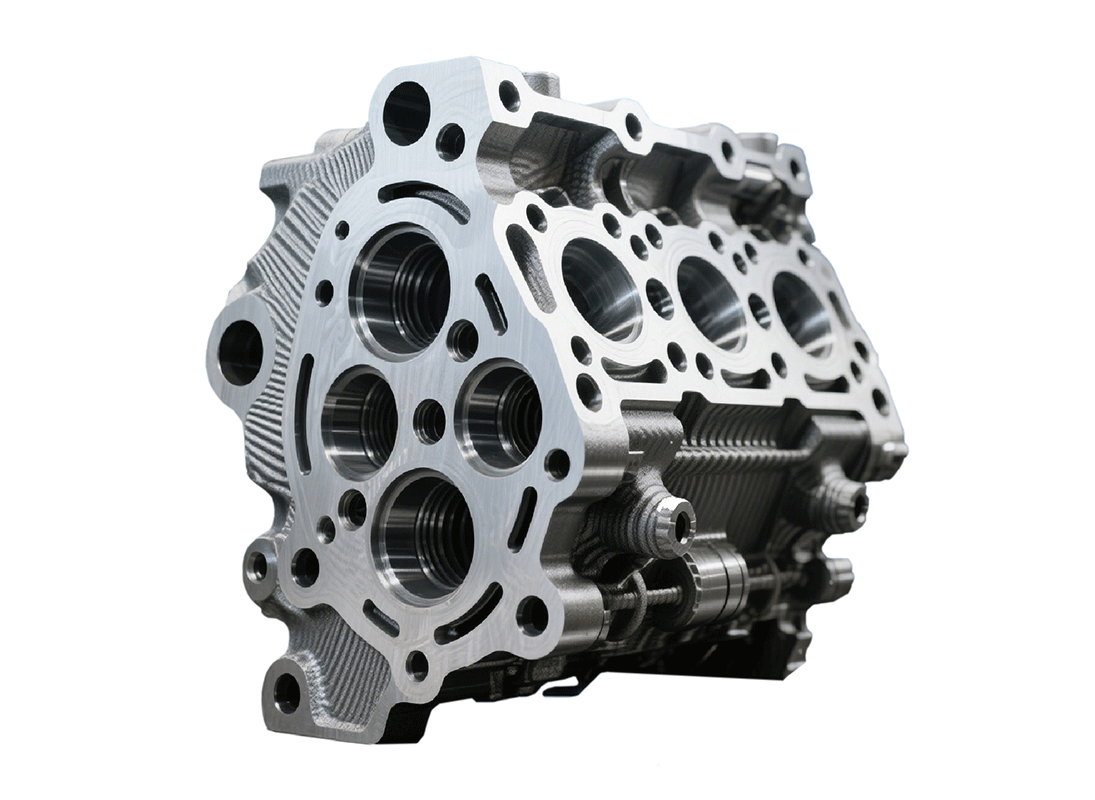
In the world of high-performance engine manufacturing, the smallest gap in precision can result in enormous consequences. A deviation of just 0.01mm in an engine block can transform a cutting-edge masterpiece into an expensive failure. For engineers and manufacturers, achieving absolute precision is non-negotiable, particularly for critical components like engine blocks. However, traditional machining methods using 3-axis or 4-axis CNC machines create inherent challenges, introducing flaws through the need for multiple setups.
Enter the game-changer: 5-axis CNC machining. By enabling single-setup precision, this technology is closing the "Precision-Reliability Gap" that has plagued the industry for decades. Let's explore how 5-axis machining centers revolutionize engine block manufacturing and position themselves as the gold standard for OEMs and high-performance production facilities.
Understanding Cumulative Error (The Setup Penalty)
Precision issues in engine block machining often stem from a phenomenon known as cumulative error. To understand how 5-axis machines eliminate this problem, we first need to unpack the causes of errors that occur during multi-setup machining processes.
What is "Datum Shift" and "Tolerance Stack-up"?
In machining terms, a datum refers to a fixed reference point or surface used to ensure alignment and accuracy. When CNC machines require multiple setups—physically repositioning an engine block to complete various machining stages—these datums reset, leading to shifts in alignment. This effect, known as datum shift, introduces tolerance stack-up, where small errors compound through each setup.
When machining something as intricate as an engine block, these errors can result in misaligned cylinder bores, off-center crankshaft journals, and uneven deck surfaces—imperfections that compromise the engine's performance, reliability, and lifespan.
Why Traditional 3-Axis Methods Fall Short
In a 3-axis setup, the machine moves the cutting tool along three planes while the engine block remains stationary. Achieving complex geometries often requires flipping the heavy casting or transferring it to alternate fixtures. Every manual or robotic touchpoint risks minute misalignments that affect critical tolerances—errors measurable only in micrometers but significant enough to cause failures under high engine stress.
Critical Geometries: Why "5-Axis Engine Block" is the Modern Standard
Transitioning to 5-axis CNC machining solves these challenges by allowing all machining operations to be performed in a single setup. With the machine moving along five simultaneous axes, complexities in engine block manufacturing become manageable, accurate, and consistent.
Cylinder Bore Circularity and Alignment
High-performance internal combustion engines rely on perfect alignment between cylinder bores and the crankshaft. Misalignment during machining can lead to inefficiencies like increased oil consumption or even catastrophic failure under high loads.
5-axis machining excels here, as it enables consistent tool paths for boring and honing cylinders, ensuring these are concentric with the crank journals. Built-in Geometric Dimensioning and Tolerancing (GD&T) protocols further refine this accuracy, eliminating the risks of errors inherent in multi-setup processes.
Intricate Oil Galleries and Cooling Passages
Modern engine designs feature increasingly complex oil galleries, cooling passages, and structural reinforcements to enhance performance and minimize engine wear. These require deep-hole drilling at compound angles—something nearly impossible to achieve with traditional machining centers.
With 5-axis capabilities, machines can drill precisely at any angle, navigating the most complex systems of internal passages without resetting or repositioning the casting. This flexibility is critical for V8, V12, and turbocharged engines with sophisticated thermal and lubrication demands.
Deck Surface Planarity
The cylinder head and block deck interface must form an airtight seal, especially in engines running high-compression or forced-induction setups. Achieving this requires deck surface planarity to be uniformly flat across all cylinders.
On 5-axis machines, the cutting tool can maintain an impeccable orientation relative to the block’s surface, machining it in a single pass while ensuring that thermal stability and vibration harmonics remain consistent. This delivers surfaces that allow for perfect gasket sealing and reliable combustion.
The Financial Impact: Faster Lead Times and Zero Scrap
Switching to one-setup machining with 5-axis technology doesn’t just enhance precision—it also provides tangible financial and operational benefits that manufacturers can’t afford to ignore.
Reduction in Labor and Scrap
Traditional multi-setup processes require skilled operators to handle fixtures and reposition workpieces. With 5-axis machines eliminating these touchpoints, manufacturers can cut labor costs, reduce human error, and ultimately achieve the coveted "zero-scrap" goal by protecting valuable castings.
Improved Tool Life and Cost Savings
By maintaining the optimal tool-to-part orientation throughout machining, 5-axis machines reduce tool deflection—a common issue that accelerates wear and reduces cutting accuracy. Tools last longer and perform better, keeping operational costs low and production quality high.
Shortened Cycle Times
Perhaps the most notable benefit of 5-axis machining centers is their ability to drastically reduce cycle times. By eliminating repositioning, combining multiple operations into a single workflow, and optimizing tool paths, manufacturers typically report cycle time reductions of 30-50% compared to traditional methods.
Achieving GD&T Perfection with ZHM Technology
When it comes to advanced engine block solutions, few match the expertise and capabilities offered by ZHM. Their innovative 5-axis machining systems are specifically designed to meet the rigorous demands of high-performance engine block manufacturing.
Why ZHM’s 5-Axis Systems Stand Out
Engineered for Heavy Castings: ZHM systems are tailored for large, heavy, and complex parts like engine blocks made from Compacted Graphite Iron (CGI) or high-grade aluminum alloys.
High Torque & Thermal Stability: By minimizing vibration harmonics, ZHM machines ensure that even critical operations like deep-pocket machining are performed with unparalleled accuracy.
Dynamic GD&T Control: Every machine is equipped with advanced software to ensure compliance with GD&T standards, delivering verified tolerances right out of the spindle.
With their state-of-the-art machining centers, ZHM empowers OEMs and Tier 1 suppliers to overcome the "Precision-Reliability Gap" with precision and repeatability.
Conclusion: The Future of Precision Block Machining
High-performance engine blocks are no longer "machined" but "engineered" through a single, streamlined digital and physical setup. By leveraging 5-axis CNC machining, manufacturers can eliminate cumulative error, cut lead times, improve material efficiency, and most importantly, deliver engine blocks that meet the demands of modern performance and durability.
If you’re looking to transform your manufacturing process, ZHM is the 5 axis cnc machining supplier to help you achieve precision, reliability, and incredible ROI.# Markdown syntax guide