English
In 2026, more manufacturers are machining heat-resistant alloys and hardened tool steels to meet aerospace, energy, medical, and high-performance tooling demands. The problem: conventional milling struggles with rapid tool wear, burrs, thermal distortion, and geometrically impossible internal corners—especially on parts that have already been heat treated. EDM machining solves many of these cases by removing material without cutting forces. This guide explains the edm machine working process, key specs, best-fit applications, and how to select the right EDM approach for cost-effective results.
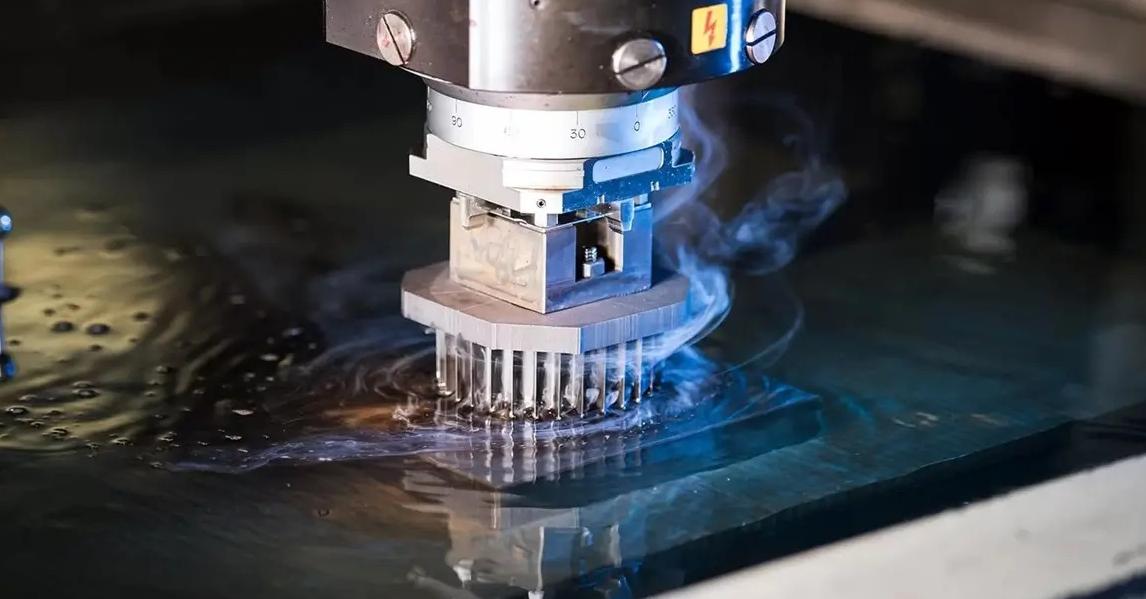
EDM Machine Working Process: How EDM Removes Metal Without Cutting Forces
Understanding the edm machine working process explains why it succeeds where conventional machining fails on difficult materials.
The fundamental mechanism:
EDM machining removes conductive material through controlled electrical discharges—sparks—between the electrode (wire or shaped tool) and the workpiece, separated by a dielectric fluid (typically deionized water for wire EDM or hydrocarbon oil for sinker EDM). Each spark generates a localized temperature of 8,000–12,000°C at the discharge point, vaporizing a microscopic amount of workpiece material. The dielectric fluid immediately quenches the plasma and flushes eroded particles away from the gap.
Why hardness becomes irrelevant:
Conventional milling removes material by mechanical shearing—the cutting tool must be harder than the workpiece, and tool wear accelerates sharply as workpiece hardness increases. The edm machine working process is thermal and electrical, not mechanical. A 65 HRC hardened tool steel erodes at essentially the same rate as the same steel at 30 HRC—hardness does not impede spark erosion. This makes EDM uniquely suited to post-hardening operations where conventional tools would wear out rapidly or cause distortion.
The force-free advantage:
Because no cutting force acts on the workpiece, EDM produces:
No tool pressure that could deflect thin walls, ribs, or delicate features
No burrs—material is vaporized, not sheared
Minimal heat-affected zone compared to conventional cutting on heat-sensitive alloys
Access to internal geometries that cutting tools cannot physically reach
The tradeoff:
The edm machine working process trades cutting force problems for process control requirements: spark gap management, dielectric fluid quality, flushing efficiency, and electrode or wire consumption. Material removal rate is slower than aggressive milling for bulk stock removal—which is why hybrid approaches (rough mill + EDM finish) often deliver the best combination of speed and precision.
Key Specs That Decide Accuracy, Speed, and Surface Quality
When submitting a part for EDM machining, the specification inputs determine cycle time, achievable tolerance, and cost per part.
EDM type selection—wire vs sinker:
| Parameter | Wire EDM | Sinker EDM |
|---|---|---|
| Geometry type | Through-cuts, profiles, contours | Blind cavities, 3D pockets |
| Achievable tolerance | ±0.002–0.005 mm | ±0.005–0.01 mm typical |
| Corner sharpness | Limited by wire diameter (min ~0.1 mm radius) | Electrode-defined (very sharp possible) |
| Surface finish | Ra 0.4–1.6 µm (multi-pass) | Ra 0.2–1.6 µm (multi-pass) |
| Setup complexity | Lower for standard through-cuts | Higher—electrode fabrication required |
Quote-critical parameters to define:
Tolerance requirements: Dimensional tolerance directly determines the number of finishing passes required. ±0.01 mm may require two passes; ±0.003 mm may require four or more, each adding cycle time.
Surface finish target: Each additional finishing pass improves Ra but adds machine time. Define the minimum acceptable Ra for your functional surface—avoid specifying mirror finish (Ra ≤ 0.2 µm) on features where it is not functionally required.
Part thickness and cut length: These are the primary drivers of wire EDM cycle time. A 100 mm thick part takes proportionally longer to cut than a 20 mm part at the same contour length. Provide accurate values, not worst-case estimates, to avoid over-priced quotes.
Corner radius requirements: Wire EDM cannot produce a perfectly sharp internal corner—the minimum internal radius equals approximately half the wire diameter plus spark gap (typically 0.06–0.15 mm minimum for standard wire). If sharp corners are functionally required, sinker EDM or a combination approach is needed.
Process controls that affect outcome:
Flushing strategy: adequate dielectric flow through the cut gap removes eroded particles and prevents re-deposition; poor flushing causes surface defects and dimensional drift
Dielectric quality: contaminated dielectric increases discharge instability and surface roughness
Fixture stability: any workpiece movement during cutting produces geometry error; confirm fixturing method for thin or irregular parts
Multi-pass strategy: rough cut removes bulk material; semi-finish and finish passes achieve final tolerance and surface quality
Where Titanium, Inconel, and Hardened Steel Benefit Most
EDM machining delivers its strongest value on specific material and geometry combinations. Understanding where it fits—and where it doesn't—prevents misapplication.
Titanium (Ti-6Al-4V and similar alloys):
Titanium's combination of low thermal conductivity, high strength-to-weight ratio, and tendency to work-harden makes it a difficult conventional milling material—especially for thin features, deep slots, and complex profiles. EDM is hardness-independent and produces no cutting force, eliminating the chatter and deflection that plague thin titanium sections. Typical applications for aerospace machining services include structural brackets with complex internal slots and turbine blade cooling hole entry profiles, while medical applications include implant components requiring precise geometry.
Inconel (718, 625, and similar superalloys):
Inconel's high-temperature strength and work-hardening rate make it one of the most tool-destructive materials in conventional machining. Tool life in Inconel milling is measured in minutes at aggressive parameters. The edm machine working process is unaffected by Inconel's mechanical properties—erosion rate depends on thermal and electrical properties, not hardness. Typical applications: turbine disk slots (fir-tree profiles), combustor components, deep cavity features in energy equipment.
Hardened tool steel (D2, H13, M2, and similar grades):
The most common EDM application domain. Heat-treated tooling steel at 58–65 HRC cannot be milled economically. EDM processes hardened steel at the same rate as soft steel—enabling hardening before final geometry machining, which eliminates post-machining distortion and allows tighter final tolerances. Typical applications: injection mold cavities and cores, stamping die inserts, extrusion tooling profiles, precision gauging fixtures.
Application summary by industry:
| Industry | Typical EDM Application | Material |
|---|---|---|
| Aerospace | Turbine disk fir-tree slots, structural slots | Inconel, titanium |
| Medical | Implant profiles, surgical instrument features | Titanium, stainless |
| Mold and die | Cavity inserts, core pins, fine details | Hardened tool steel |
| Energy | Turbine component features, heat exchanger parts | Inconel, alloy steel |
| Precision tooling | Gauges, fixtures, EDM electrodes | Hardened steel |
When EDM is not the right choice:
Large volume bulk material removal where rough milling is 10–50x faster—use milling for roughing, EDM for finishing only
Non-conductive materials (ceramics, plastics, composites)—EDM requires electrical conductivity
Parts where the heat-affected zone from spark erosion is unacceptable for the specific application (rare, but relevant for some fatigue-critical surfaces)
How to Choose Wire vs Sinker EDM for Your Part
Matching the edm machine working process type to the part geometry is the first and most important selection decision.
Wire EDM is the right choice when:
The feature is a through-cut—the wire must pass completely through the part thickness
The geometry is a contour, profile, slot, or shaped aperture visible from above
Tolerance targets are ±0.003–0.01 mm on profile
Internal corner radii of 0.08–0.15 mm are acceptable
Sinker EDM is the right choice when:
The feature is a blind cavity—it does not pass through to the other side
Three-dimensional internal geometry (pockets, impressions, complex profiles) is required
Very sharp internal corners are needed (electrode can be ground to near-zero radius)
Deep narrow features require shaped electrode access
Selection workflow:
Step 1 — Define geometry type Is the feature a through-cut or blind cavity? This single question determines wire vs sinker in most cases.
Step 2 — Set tolerance and finish targets Map each feature to its functional requirement. Avoid applying the tightest tolerance uniformly—identify which surfaces are truly critical and which can accept standard EDM finish.
Step 3 — Choose rough + finish strategy For parts with significant stock to remove before EDM features, hybrid machining (rough mill to within 0.5–1.0 mm of final geometry, then EDM to final dimension) reduces total cycle time and cost compared to EDM from solid.
Step 4 — Confirm lead time based on thickness and cut length Wire EDM cycle time scales with part thickness × cut perimeter length × number of passes. A 100 mm thick part with 500 mm of contour at four-pass finish will take significantly longer than a 20 mm part with the same contour. Get an accurate time estimate before committing to delivery commitments.
What Drives Cost Per Part—and How to Reduce It
For EDM machining, TCO is driven by machine time, consumables, setup complexity, and inspection requirements—not energy consumption.
Primary cost drivers:
Machine time: The dominant cost factor. Determined by part thickness, total cut length, number of finish passes, and material erosion rate. Thick parts in difficult alloys with tight tolerances requiring multiple passes are the highest-cost combination.
Wire and electrode consumption: Wire EDM continuously feeds fresh wire—wire diameter, cutting speed, and cut length determine wire consumption per part. Sinker EDM requires custom electrodes, which carry fabrication cost and wear over multiple cavities.
Setup and fixturing: Complex parts requiring custom fixtures or multiple setups add setup time to every batch. Design parts with clear datum features and accessible wire threading locations to minimize setup complexity.
Inspection requirements: CMM inspection, surface finish measurement, and first-article reporting add cost but are often required for aerospace, medical, and precision tooling applications. Define inspection requirements clearly upfront to avoid scope changes after quoting.
Practical cost reduction strategies:
Use hybrid machining: rough mill to near-net, EDM only critical features that require it
Rationalize tolerance specifications: apply tight tolerances only to functional surfaces; standard EDM finish (Ra 1.6 µm, ±0.01 mm) on non-critical surfaces reduces pass count and cycle time
Batch similar parts: setup amortization across larger quantities reduces per-part cost significantly
Avoid unnecessary surface finish upgrades: specifying Ra ≤ 0.4 µm when Ra .8 µm is functionally adequate adds finish passes and cost without functional benefit
Reliability and consistency practices:
Maintain dielectric filtration on a scheduled basis—contaminated dielectric is a leading cause of surface quality drift and dimensional inconsistency
Monitor wire tension and feed rate for consistency across long cuts
Confirm fixture clamping force is sufficient to prevent workpiece movement during extended cutting cycles on thin or tall parts
Conclusion
For titanium, Inconel, and hardened tool steel, the challenge is rarely whether the part can be made—it is whether it can be made accurately without destroying tools, distorting the part, or creating burrs that require secondary finishing. EDM machining delivers force-free precision and access to geometries that conventional tools cannot reach. The best results come from matching the edm machine working process—wire vs sinker—to the part geometry, then optimizing tolerance and finish specifications for cost-effective production.
Ready to evaluate your part for EDM?
Visit the EDM machining service page and submit the following to receive a recommended EDM strategy and quotation:
Operating conditions: material (titanium, Inconel, tool steel), heat-treated status, application environment
Quantity: prototype quantity and monthly or annual production forecast
Size and specs: part thickness, overall dimensions, cut length, through-cut or blind cavity requirement
Target metrics: tolerance, surface finish, corner radius requirements, lead time target
Current problems: tool wear or chatter in milling, burrs, distortion after heat treatment, impossible internal corners, long cycle time
FAQ
Q1: What is EDM machining?
EDM machining is a process that removes conductive material using controlled electrical discharges in a dielectric fluid—enabling precision cutting without mechanical cutting forces, making it effective for hardened steels, titanium, and superalloys.
Q2: EDM vs CNC milling for hardened steel—what is the main difference?
CNC milling uses cutting tools and is strongly affected by workpiece hardness—tool wear accelerates sharply above 50 HRC. The edm machine working process is thermal and electrical, largely hardness-independent, and excels at precision features and post-hardening operations where milling is impractical.
Q3: When does EDM provide the best ROI?
ROI is strongest when EDM machining prevents expensive tool breakage, eliminates distortion from post-hardening machining, enables geometries that avoid multi-part assemblies, or removes the need for secondary burr removal and finishing on critical features.
Q4: Do I need to redesign my parts to use EDM?
Not always. Most parts can be processed as designed. However, clarifying corner radius limits, identifying hybrid milling and edm machine working process boundaries, and adding small relief features where tool access is tight can reduce cycle time and cost without changing functional design intent.
Q5: What parameters are needed for an accurate EDM quote?
Provide material type and hardness, part thickness and overall dimensions, cut length and geometry (through-cut or blind cavity), tolerance and surface finish targets, quantity, and any special requirements such as micro-features, sharp corner specifications, or inspection report requirements for accurate EDM machining scoping.