English
In 2026, motorsport programs are pushing higher boost pressures, tighter thermal limits, and faster iteration cycles—while failure tolerance keeps shrinking. Cast blocks can be cost-effective, but porosity risk, limited material placement control, and long pattern and tooling cycles often slow development. A cnc engine block machined from billet—especially with a 5 axis engine block process—gives teams tighter control over geometry, rigidity, and oil and coolant routing, helping improve reliability under extreme loads.
What Is a CNC Engine Block and Why Does Billet Change the Performance Equation?
A cnc engine block is an engine block produced using CNC machining—starting from solid billet stock and removing material precisely to create the final block geometry, rather than pouring metal into a mold and finishing the casting.
The billet concept:
Billet machining begins with high-integrity wrought or forged stock—typically 6061-T6, 7075-T6 aluminum, or high-grade steel—where the grain structure is uniform and free from the internal voids that casting processes inherently risk. The final block geometry is entirely defined by the CNC program, not by mold fill behavior or cooling rate variation.
Why billet improves consistency over cast:
Cast blocks are produced by filling a mold with molten metal. Despite advances in casting technology, the process introduces variability that matters at the performance limit:
Porosity: microscopic voids form as gas escapes during solidification—invisible externally but capable of propagating into cracks under cylinder pressure cycling
Shrinkage variation: uneven cooling rates create dimensional inconsistencies in bore spacing, main web geometry, and deck flatness
Internal defect unpredictability: X-ray or CT inspection can detect gross defects, but near-surface porosity in critical stress zones often escapes detection until failure
A cnc engine block machined from billet eliminates these variables. Wall thickness is controlled by the tool path, not by mold fill. Reinforcement ribs go exactly where structural analysis demands them—not where a casting pattern allows.
Performance mechanism:
Precise main bearing housing bore alignment reduces bearing load concentration and crankshaft deflection under high-rpm load
Controlled deck flatness minimizes head gasket stress concentration and reduces head lift risk under high-boost combustion pressure
Designed-in stiffness at main webs and cylinder sleeves reduces bore distortion, improving ring seal and reducing blowby
5 Axis Engine Block Specs: Critical Features That Determine Race-Ready Performance
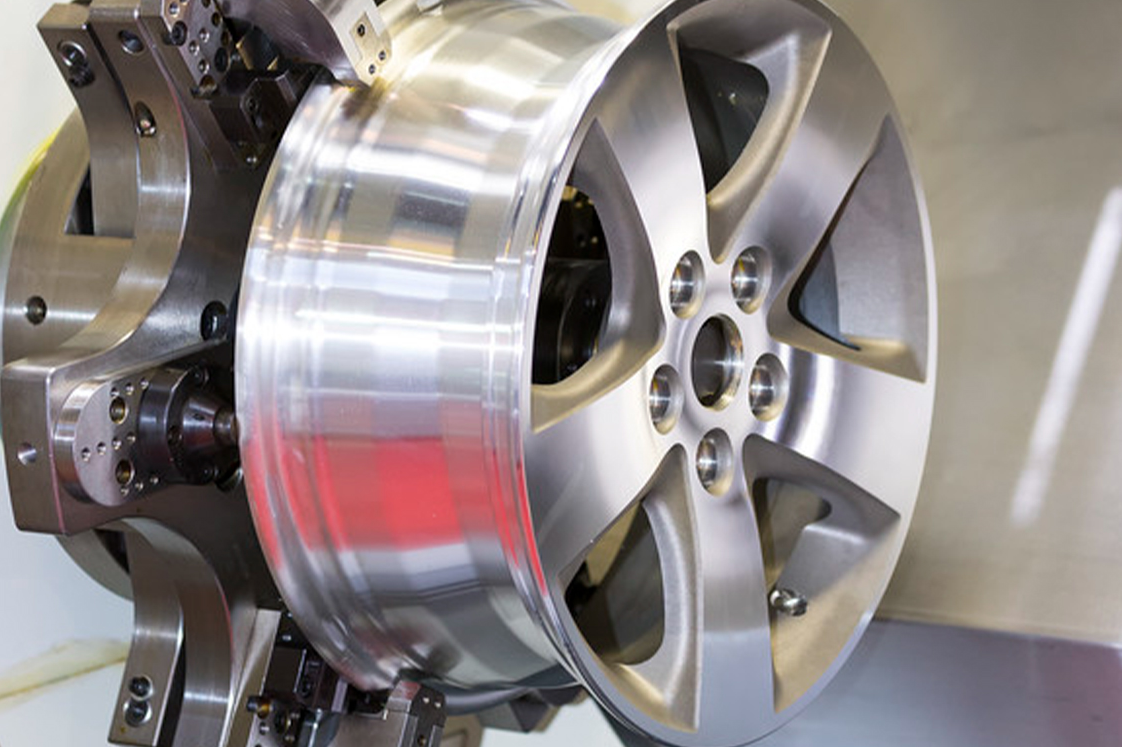
The machining process itself determines whether a billet block delivers on its material advantage. A 5 axis engine block machining approach—where the cutting tool can approach the workpiece from five axes simultaneously—enables geometric accuracy on complex multi-face features that 3-axis machining cannot reliably achieve.
Why 5-axis machining matters for engine blocks:
Engine blocks are among the most geometrically complex machined components in motorsport. Cylinder bores, main bearing tunnels, cam tunnels, oil galleries, coolant jackets, and head bolt bosses exist on multiple faces and require precise relative positioning. Any accumulated setup error across multiple 3-axis operations introduces stack-up tolerances that affect bore alignment, bearing crush, and gasket sealing.
A 5 axis engine block process machines multiple critical faces in fewer setups—often a single setup for major features—eliminating re-fixturing error and improving dimensional consistency across production blocks.
Critical specs teams lock down:
Main bore alignment and housing bore tolerances: Main bearing tunnel roundness and alignment directly affect crankshaft bearing load distribution. Typical race-spec tolerances: bore roundness ±0.005 mm, bore-to-bore alignment ±0.01 mm across the full tunnel length.
Deck flatness and cylinder spacing: Deck flatness targets of 0.025 mm or better across the full head surface prevent localized head gasket loading. Cylinder spacing tolerance affects rod angularity and piston side load.
Cylinder sleeve strategy: Pressed-in sleeves, interference-fit sleeves, or siamesed bore construction—each with different thermal expansion behavior and serviceability implications. The billet block allows sleeve pocket geometry to be machined to exact interference fit specification.
Oil gallery routing and priority main oiling: Billet construction allows oil passages to be drilled or gun-drilled to exact diameter, length, and intersection angle. Priority main oiling circuits (where main bearings receive pressurized oil before cam bearings) are straightforward to implement in billet but difficult to achieve reliably in a casting.
Cooling jacket routing: Targeted coolant flow around exhaust valve bridge areas and top ring reversal zones reduces thermal gradient and bore distortion. Billet construction allows cooling jacket geometry to be optimized from thermal simulation data.
Tolerance and finish targets:
| Feature | Typical Race Spec | Effect on Performance |
|---|---|---|
| Main bore roundness | ±0.005 mm | Bearing load distribution |
| Deck flatness | ≤ 0.025 mm | Head gasket sealing integrity |
| Cylinder bore finish | Ra 0.4–0.8 µm | Ring seal and oil film stability |
| Bore-to-bore alignment | ±0.01 mm | Crankshaft deflection and bearing life |
| Oil gallery diameter consistency | ±0.05 mm | Oil flow rate and pressure stability |
CNC Engine Block Applications: When Billet Beats Cast—and When Cast Still Wins
A cnc engine block is not the right answer for every application. Understanding where billet delivers genuine performance advantage versus where it adds cost without proportional benefit is essential for accurate budget allocation.
Billet is typically the right choice when:
High boost / high cylinder pressure builds: Turbo and supercharged engines generating peak cylinder pressures above 120–140 bar place extreme tensile load on main webs and head bolt bosses. Billet construction with designed-in reinforcement at these locations reduces failure risk significantly.
Limited-run race programs needing fast design revision: A casting requires pattern tooling—lead times of 8–16 weeks and tooling costs of $15,000–$50,000+ depending on complexity. A billet program can revise a CAD file and machine a revised block in days. For a team running a one-season development program, this iteration speed is often worth the per-unit cost premium.
Custom architectures: Unique bore spacing, non-standard deck heights, integrated dry sump provisions, or custom accessory mounting—none of these require tooling investment in a billet program.
When hidden defects are unacceptable: In endurance racing, a single block failure can cost more in entry fees, travel, and program time than the entire cost premium of billet construction for a season.
Cast blocks still make sense when:
Spec series rules mandate a specific production block
High-volume production cost requirements dominate the decision
A proven casting with extensive durability data at the target power level exists and the failure risk is quantified and accepted
Budget constraints make billet economics impractical for the program scope
How Teams Specify, Validate, and Iterate a 5 Axis Engine Block Program
The process of bringing a 5 axis engine block from concept to race-ready hardware follows a structured workflow that leverages the speed advantage of billet machining.
Step 1 — Define engine targets Power level, peak boost pressure, maximum RPM, race duration and duty cycle, fuel type (pump, E85, methanol, or race gasoline), and thermal management strategy. These targets drive every subsequent structural and geometric decision.
Step 2 — Identify failure modes to design out Review failure history from previous builds or competitive intelligence: main web cracking, bore distortion at high thermal load, head lift, oil starvation at high lateral G, or bearing failure from misalignment. Each identified failure mode maps to a specific design feature in the block.
Step 3 — Create CAD model and tolerance map Define critical-to-performance (CTP) features versus non-critical features. CTP features (main bores, deck surface, sleeve pockets, oil galleries) receive tight tolerances and dedicated inspection steps. Non-critical features receive standard machining tolerances to avoid cost inflation.
Step 4 — Prototype machining and metrology First article inspection using CMM (coordinate measuring machine) verifies all CTP dimensions against the tolerance map. Oil gallery pressure testing confirms circuit integrity. Bore alignment verification across the full main tunnel length confirms setup quality.
Step 5 — Assembly fit validation Crank, bearings, rods, pistons, heads, and accessories are assembled and checked for clearances, interference fits, and oil pressure at cranking speed. Any interference or clearance issue triggers a CAD revision—typically a 3–5 day turnaround in a billet program versus 8–16 weeks for a cast revision.
Iteration advantage:
This is where the cnc engine block billet approach creates compounding value. A team that can complete two design iterations in the time a competitor waits for revised casting tooling enters the season with a more validated, better-understood engine package.
TCO and Lifecycle ROI: How Racing Teams Justify Billet
The cost comparison between billet and cast blocks is straightforward on the purchase order—billet costs more per unit. The TCO comparison, when failure consequences are included, often reverses the conclusion.
TCO drivers for racing programs:
Engine rebuild frequency: A billet block with better bore roundness, reduced distortion, and controlled oiling typically runs longer between rebuilds—reducing rebuild labor, consumable parts cost, and downtime.
Failure cost: A single catastrophic block failure in a race event costs entry fees, travel expenses, crew time, and potentially championship points. A billet block premium of $3,000–$8,000 (depending on configuration) is often recovered by avoiding one failure event per season.
Block serviceability: Billet blocks can be designed with thread inserts at high-stress bolt locations, replaceable wear surfaces in sleeve pockets, and surface repair capability at deck and rail surfaces—extending serviceable block life across multiple rebuild cycles.
Lead time reliability: In-season replacement of a failed cast block may require 8–12 weeks for a new casting. A billet block program with a machining partner can often deliver a replacement in 2–4 weeks, reducing championship-impact downtime.
Maintenance considerations:
Inspect main web faces and head bolt boss areas for fatigue cracking at every major rebuild interval
Track torque cycles on head bolts and main cap bolts—replace fasteners per specification rather than on condition
Measure bore roundness and deck flatness at each rebuild to quantify distortion accumulation over engine life
Review oil gallery cleanliness and gallery plug integrity at every teardown
Conclusion
For high-performance racing builds, a cnc engine block machined from billet is increasingly the preferred choice for teams that cannot afford the variability of casting—where stiffness, alignment, oiling reliability, and thermal stability are the variables that determine whether an engine finishes or fails. A 5 axis engine block machining process supports tighter tolerances, faster design iteration, and better geometric control on complex multi-face features—advantages that compound across a full development season.
The economics make sense when a single failure costs more than the billet premium, and when iteration speed is a competitive differentiator.
Ready to discuss your engine block project?
Visit the cnc engine block product page and submit the following to receive a recommended machining approach and quotation:
Operating conditions: target power, boost pressure, RPM, race duration, fuel type, thermal limits
Quantity: prototype quantity and seasonal production volume
Size and specs: bore spacing, deck height, cylinder count, main bearing sizes, material preference
Target metrics: stiffness goals, weight target, oiling strategy, tolerance and finish requirements
Current problems: cracked mains, bore distortion, head lift, oil starvation, inconsistent cast quality, lead-time bottlenecks
FAQ
Q1: What is a CNC engine block?
A cnc engine block is an engine block produced using CNC machining—typically from billet stock—to achieve precise geometry, controlled wall thickness, and repeatable critical alignments that casting processes cannot consistently deliver at the performance limit.
Q2: Billet vs. cast—what is the biggest practical difference?
Cast blocks are formed in molds and cost-effective at volume but carry variability risks from porosity and shrinkage. A cnc engine block machined from billet starts from uniform stock and delivers geometric consistency controlled entirely by the CNC program—critical for high-boost, high-cycle race applications.
Q3: How do racing teams justify the cost of billet blocks?
ROI comes from reduced failure risk, improved repeatability across rebuilds, faster design iteration without tooling delays, and lower program downtime cost. When a single failure event costs more than the billet premium, the economics favor a 5 axis engine block approach.
Q4: Do billet blocks require changes to existing engine setups?
Often they can be designed to match existing interfaces—heads, crank, accessories, and series regulations. However, oiling and cooling layout improvements that a cnc engine block enables may require complementary changes to the oiling system or cooling circuit to capture full performance benefit.
Q5: What parameters are needed to quote a 5 axis engine block project?
Provide CAD model or detailed drawings, target power and boost, material preference, bore and main bearing specifications, tolerance requirements, quantity, inspection expectations, and interface constraints. This data allows accurate scoping of the 5 axis engine block machining program and quotation.