English
A part does not need to look complicated to create a difficult machining problem. Sometimes the challenge is hidden in a single angled surface, a deep cavity, a curved transition or several features that must stay precisely aligned with one another. A conventional three-axis machine may be able to produce such a component, but doing so could require multiple setups, longer tools or additional fixturing.
This is where 5-axis CNC machining becomes more than an upgrade in machine capability. By changing the tool orientation during machining, five-axis equipment can reach difficult surfaces with fewer repositioning operations and maintain a more favorable cutting angle across complex geometries. The real question for engineers, however, is not whether five-axis machining is more capable, but whether that capability solves a specific manufacturing problem. For some parts, it can significantly simplify production; for others, three-axis machining remains the more practical choice.
What Makes 5-Axis CNC Different
Five-axis machining allows a cutting tool and workpiece to be oriented along multiple axes during the machining process. A conventional three-axis machine moves the tool along the X, Y and Z axes, while a more complex component may need to be removed and repositioned before another surface can be reached. Five-axis equipment adds rotary movement, allowing the cutting tool to approach different surfaces from changing directions.
The important distinction is therefore not simply the number of axes. The real advantage is the ability to control the angle between the cutting tool and the workpiece. This can make it easier to reach angled, curved or recessed features without relying on a long sequence of repositioning operations.
Consider a component with several surfaces positioned at different angles. On a three-axis machine, the part may need to be rotated and secured several times. Each additional setup takes time and creates another opportunity for alignment errors. With five-axis machining, multiple surfaces may be accessible within one setup, depending on the machine configuration and part geometry.
This setup reduction can be particularly valuable when several features must maintain a precise positional relationship. Instead of establishing a new alignment for every operation, more of the component can be produced from a consistent reference position.
When 5-Axis Capability Adds Real Value
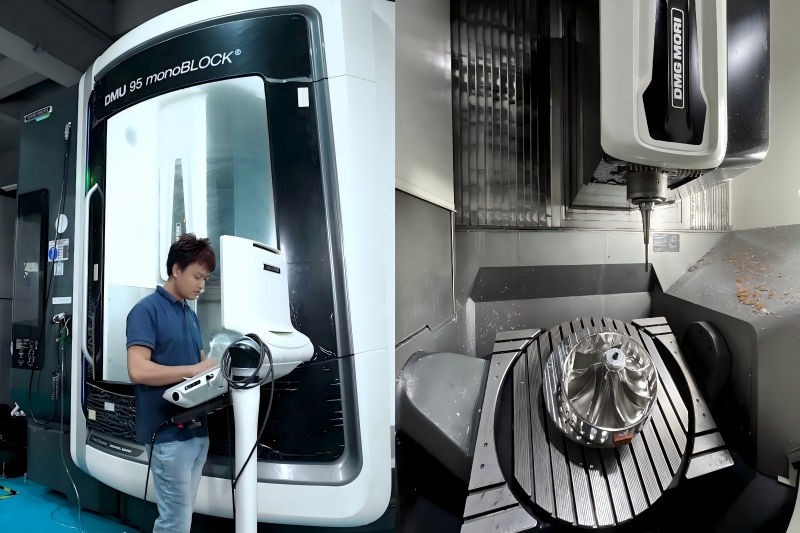
The strongest case for five-axis machining usually appears when the geometry itself makes conventional machining inefficient. Complex impellers are a good example. Their blades contain curved surfaces that must be approached from changing directions, making tool orientation an important part of the machining strategy.
Aerospace components can create similar challenges. Structural parts may include deep pockets, angled walls, curved transitions and multiple surfaces that need to remain accurately related. A three-axis process may still be possible, but it could require additional fixtures and setups that increase handling time and process complexity.
Medical components and precision molds can also benefit when their designs contain compound curves, angled features or difficult-to-access surfaces. In these applications, five-axis capability can help simplify the path from the digital model to the finished component by allowing the cutter to approach the geometry from more appropriate directions.
Another situation involves deep features that would otherwise require long cutting tools. Tool length has a direct effect on rigidity. As the tool extends farther from the holder, the risk of deflection and vibration can increase. By changing the machining orientation, five-axis equipment may allow a shorter and more rigid cutter to reach the same surface.
Reducing setups can also reduce handling time, but this should not be confused with an automatic reduction in total machining time. Five-axis programming can be more demanding, and some simple parts may actually be faster to produce on three-axis equipment. The value appears when better access, fewer setups and improved tool orientation compensate for the additional programming and machine complexity.
Tool Orientation and Surface Quality
Tool orientation is one of the defining advantages of five-axis machining when working with freeform or compound surfaces. Instead of maintaining a fixed cutting direction, the tool can tilt and rotate as it follows the geometry.
This allows the cutter to maintain a more suitable relationship with the surface being machined. Depending on the application, that can help create more consistent cutting conditions and reduce the need to machine difficult areas with an unfavorable tool angle.
Surface quality can benefit as well, particularly during finishing operations. A more appropriate tool orientation may allow the cutter to follow curved surfaces more effectively and reduce excessive tool engagement or uneven cutting behavior.
However, a five-axis machine does not automatically produce a better surface finish. The final result depends on the complete machining system, including tool geometry, cutting parameters, spindle performance, machine rigidity, workholding and programming quality.
Tool access is another important consideration. When the machine can change the orientation of the cutter, the programmer may be able to avoid using unnecessarily long tools. A shorter cutter generally provides better rigidity, which can be useful when machining deep cavities, narrow passages or complex recessed features.
For this reason, five-axis machining should be viewed as a process-control advantage rather than simply a way to move the cutter in more directions.
5-Axis vs. 3-Axis: A Practical Decision
A simple prismatic component may not justify five-axis machining. If the part consists mainly of flat surfaces, conventional pockets and accessible holes, three-axis machining can often complete the work efficiently with a small number of setups.
The calculation changes when the part contains multiple angled surfaces, compound curves or features that are difficult to reach. In these cases, three-axis machining may require repeated repositioning, specialized fixtures or long cutting tools. The resulting process can become more complicated than the original part design suggests.
| Factor | 3-Axis CNC | 5-Axis CNC |
|---|---|---|
| Simple planar features | Highly suitable | May provide little additional value |
| Multiple angled surfaces | Often requires additional setups | More flexible tool access |
| Compound curved surfaces | More challenging | Better control of tool orientation |
| Setup count | May increase with part complexity | Can be reduced for suitable geometries |
| Programming | Generally simpler | More demanding |
| Typical application | Simple to moderately complex parts | Complex multi-surface components |
The decision should therefore be based on the complete manufacturing process rather than the machine's specification sheet. A three-axis machine may have a lower hourly rate, but if the part requires several setups, additional fixtures and repeated alignment checks, the total manufacturing cost can increase.
On the other hand, using five-axis equipment for a straightforward part may add programming and equipment costs without delivering a meaningful production benefit. Zhihui Precision offers both 3-axis CNC machining and five-axis machining, making it possible to match the process with the actual geometry and manufacturing requirements rather than forcing every project into the same machining method.
What Buyers Should Specify
A machining supplier needs enough technical information to determine whether five-axis capability is actually appropriate. A complete 3D CAD model is an important starting point, but it should be supported by the dimensions, tolerances and quality requirements that define the finished component.
Material should be specified clearly because machining behavior varies between aluminum alloys, stainless steels, titanium, engineering plastics and other materials. Surface-finish requirements are also important, particularly when certain surfaces are functional or require a specific finishing process.
Production volume can influence the preferred machining strategy as well. A prototype may justify more programming time if it reduces fixture development, while repeat production may place greater emphasis on cycle time, process repeatability and setup efficiency.
Critical datums should be identified so the machining team understands which surfaces and features establish the dimensional reference system. Features that must maintain a specific positional relationship should also be clearly defined.
It is useful to identify potentially difficult features before production begins. Deep pockets, undercuts, compound angles and recessed surfaces can all affect cutter selection, workholding and machine orientation. Early engineering review can reveal whether five-axis machining will simplify these challenges or whether another process would be more appropriate.
Inspection requirements should be considered at the same stage. Tight tolerances and complex freeform surfaces require an inspection strategy that can verify the finished geometry. Machining and inspection should work together rather than treating measurement as something that happens only after the component has been produced.
Why Engineering Capability Matters
Machine capability is only one part of successful five-axis manufacturing. The engineering team needs to understand how the part geometry, tool path, fixture, machine kinematics and inspection strategy interact.
Five-axis programming is especially important for complex components. The tool path needs to provide the required surface coverage while maintaining appropriate cutting conditions and avoiding collisions. Tool orientation can change cutting forces and tool engagement, so programming decisions can directly influence machining stability and surface quality.
Workholding also deserves careful consideration. The fixture must provide sufficient rigidity while leaving enough clearance for the cutting tool to reach the required surfaces. A poorly designed fixture can restrict the movement that the five-axis machine was selected to provide.
Process planning becomes even more important when a component moves from prototype to repeat production. A process that works for one prototype may not offer the best balance of cycle time, tool life, inspection and repeatability when production volume increases.
Zhihui Precision combines five-axis machining with engineering support and an MES-based production workflow. This combination can be useful when a project requires more than basic machine access and needs a controlled process that can support prototype evaluation and repeat production.
Frequently Asked Questions About 5-Axis CNC Machining
1. Does every complex CNC part require 5-axis machining?
No. A part can appear complex without actually requiring five-axis machining. If its important features can be reached efficiently with three-axis equipment and a reasonable number of setups, three-axis machining may be more economical. Five-axis capability becomes more valuable when geometry creates difficult tool-access conditions, excessive setup requirements or challenging positional relationships.
2. What types of parts benefit most from 5-axis CNC machining?
Parts with compound curves, multiple angled surfaces, deep cavities and closely related features are common candidates. Impellers, aerospace structures, precision molds and certain medical components can benefit because the cutting tool can approach complex surfaces from more suitable directions.
3. Does 5-axis machining automatically provide better surface quality?
No. Five-axis movement can improve tool orientation and access, which may support better surface quality on suitable geometries. However, the finished result also depends on cutter selection, cutting parameters, tool paths, machine rigidity, workholding and material behavior.
4. Is 5-axis machining always more accurate than 3-axis machining?
Not necessarily. Five-axis machining can reduce the number of setups for certain components, potentially reducing opportunities for repositioning errors. Actual accuracy still depends on machine calibration, programming, fixturing, workholding and inspection. A well-planned three-axis process can deliver excellent accuracy when the part geometry is suitable.
5. What information should buyers provide when requesting 5-axis machining?
Provide the 3D CAD model, critical dimensions, tolerances, material, surface-finish requirements and expected production volume. It is also helpful to identify important datums and features that must maintain specific positional relationships. These details allow the machining team to evaluate tooling, fixturing, access and inspection requirements before production.
6. How can I determine whether 5-axis machining is worth the additional cost?
Compare the complete manufacturing process rather than looking only at the machine rate. Consider setup count, fixture requirements, programming time, tool access, cycle time, inspection requirements and the potential for repositioning errors. If five-axis machining reduces several of these factors or improves process consistency, its higher machine cost may be justified.
The most capable machine is not automatically the right machine for every part. The better approach is to start with the geometry, tolerances, surface requirements and production objectives, then determine which machining process can meet them efficiently. For straightforward components, three-axis CNC machining may remain the most practical solution. When difficult angles, compound curves, deep features and multiple related surfaces dominate the design, 5-axis CNC machining can provide a meaningful advantage by reducing setups and improving tool access.
Ultimately, the value of five-axis capability comes from how effectively it solves a real manufacturing problem. A clear technical specification and an engineering team that can evaluate tool paths, fixturing, tolerances and inspection requirements will make it easier to select the right process and avoid unnecessary machining complexity.